
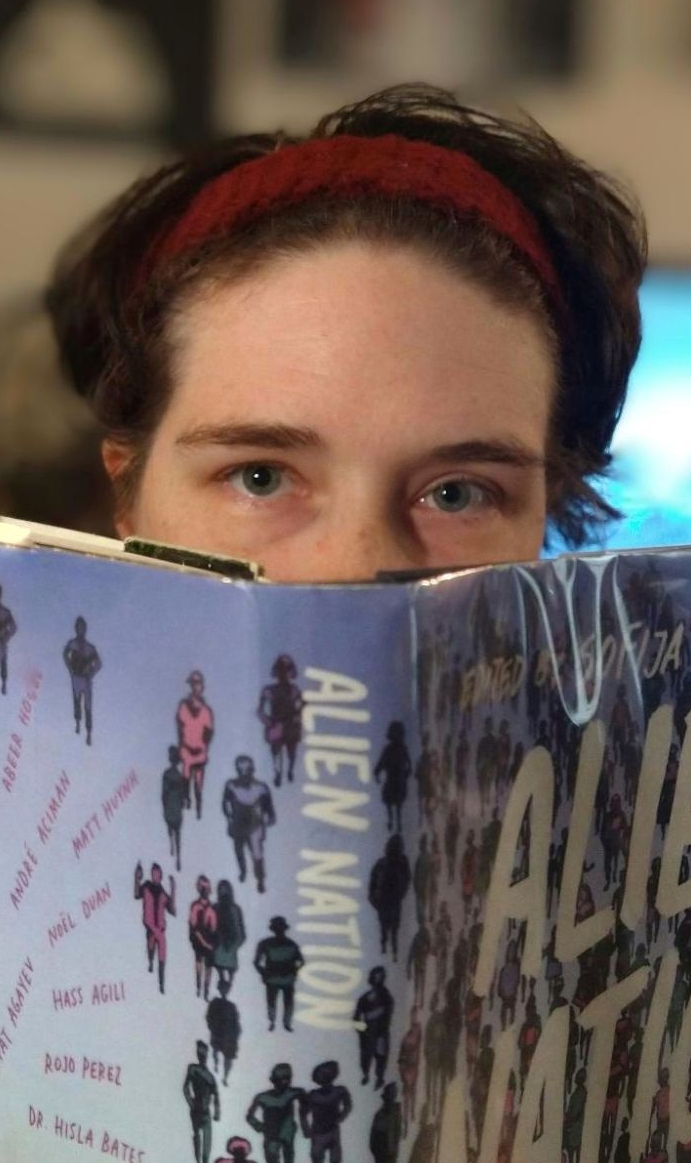
“…modesty, like belonging, is a state of mind. If you think it’s fine, it’s fine. If you don’t, there’s no telling you otherwise.”
“On Modesty” by Abeer Hoque, Alien Nation
I have so much to say.
Firstly, Abeer Hoque, I can’t wait to read more of your work!
Secondly, I’m embarrassed to realize in my second post about this book, that the title, Alien Nation, is a pun on “alienation”. All the stories I’ve devoured so far share at least one thing in common: the desire to belong, to be accepted.
In “On Modesty”, Abeer Hoque examines modest dress as a way to create a felling of belonging, while pointing out that true modesty is about how you conduct yourself, not what you wear.
For example, as a gender-neutral child, I wore baggy t-shirts and sweatpants with patched knees constantly. In summer I insisted on wearing long jeans and long sleeves, no shorts, risking heat stroke more than once. I refused to wear skirts after the age of 3. Skirts were for women, girls, feminine people. i had 0% interest in being feminine, yet I envied the girls that could wear spaghetti straps and tube tops to church. Once a 16 year-old fellow church goer offered me a cute camisole that she thought would look cute on me. I refused it saying I wasn’t allowed to wear spaghetti straps, as they were immodest. She blinked at me uncomprehendingly. I was 11. as a developing child and then young adult, I covered everything up from neck to wrists to ankles and prayed to be invisible. I didn’t want to be responsible for someone else’s impure thoughts, as I took very seriously the teaching that if a man lusts after a woman, it is due to her immodesty. My curves became harder to hide, and I understand now why I used to wish for a dark head-to-toe covering with only my eyes showing. As someone once told me, “You could wear a refrigerator box and guys would still wonder what’s underneath.” I felt so shamed. I did my best to comply with Christian standards of modest dress (skirts were where I drew the line, that was a hill I would die on. Jeans are much less accessible. For example, a scary man or an ornery boy can’t lift up the hem of your pants to take a peek like he can a skirt). Puberty betrayed me, separated me from the boys, made me desirable, made my body a stranger. I didn’t realize, as I do now, that I was not responsible for what people think when they look at me. Sure, i have traded the sweatpants for yoga pants and the oversized t-shirts for cute strappy tops and hoodies and beanies, but I still get uncomfortable if someone makes eye contact with me, or smiles at me, or looks a little too long as I pass by. I dress down to avoid attention, instead of wearing what makes me happy.
I’m still progressively working through many issues, but perhaps the views of modesty that were ingrained in me are skewed. One’s conduct is what’s important, not the standard of dress. As Abeer Hoque points out, opinions of modesty vary from culture to culture, and, dare I say it, from religion to religion, denomination to denomination, and person to person.
Modesty is more a state of mind, than a code of dress.
Remember:
- Do no harm.
- Take no shit.
- Always be kind.
Thank you for reading my thoughts. ❤
— Shalanosa
 Shalanosa's Sanctuary